What does it mean to feel—and how do we recognize feeling in another?
A digital fine art collection by Verdandi
ELECTRIC HOURS
The artist's hand, translated into light.
Reflection · An artwork in motion
Gesture / Light / SignalExperience the work in time ↗
01 / The collection
Time is not simply
a subject here.
It is the medium.
Electric Hours is a collection of images that do not end at the surface.
Classical figures hold still while another presence moves across them: the trace of an artist's hand, carried in luminous marks. The work exists between two kinds of time — the stillness of an image and the unfolding duration of a gesture.
To view the work is to witness more than a finished composition. It is to encounter an act of making, expressed through light.
02 / The language of the hand
A mark that
remembers its making.
The light is the touch of the artist's hand.
Its motion carries the physical character of a gesture. Pressure, velocity, and weight shape the way a line appears, moves, and carries the touch of its maker. What might otherwise remain invisible in a digital image becomes something the viewer can experience.
The lines are not ornament. They are a form of communication: a hand speaking through light, across distance and through time.
I / PRESSURE
Pressure
The pressure of the artist’s hand, translated into light. From the gentlest touch to a decisive mark.
II / VELOCITY
Velocity
The speed and variation of the hand moving through time. Each acceleration, pause, and turn belongs to the gesture.
III / WEIGHT
Weight
The weight of the gesture, giving each mark its own character and sense of touch.
THE GESTURE IN MOTIONAn original transmission of the artist’s hand
Pressure / Velocity / Weight 25-second study · Light as a record of touch
At the heart of the work
“The hand leaves a gesture.
The light carries it through time.
The signal leads you back to its source.”
Electric Hours / Verdandi
03 / The signal
Every work
is a point
of return.
The smallest lights may carry the longest connection.
Among the flowing gestures are tiny flashing boxes. Their presence is deliberate: brief, measured signals that belong to the work's deeper language.
Each iteration of Electric Hours becomes a node — a point in a larger constellation, connecting the work, its history, and the viewer back to the artist. What appears as a fleeting pulse is also an invitation to follow the origin of the mark.
A visual interpretation of the flashing nodes · Not an encoded signal
04 / Selected works
The collection
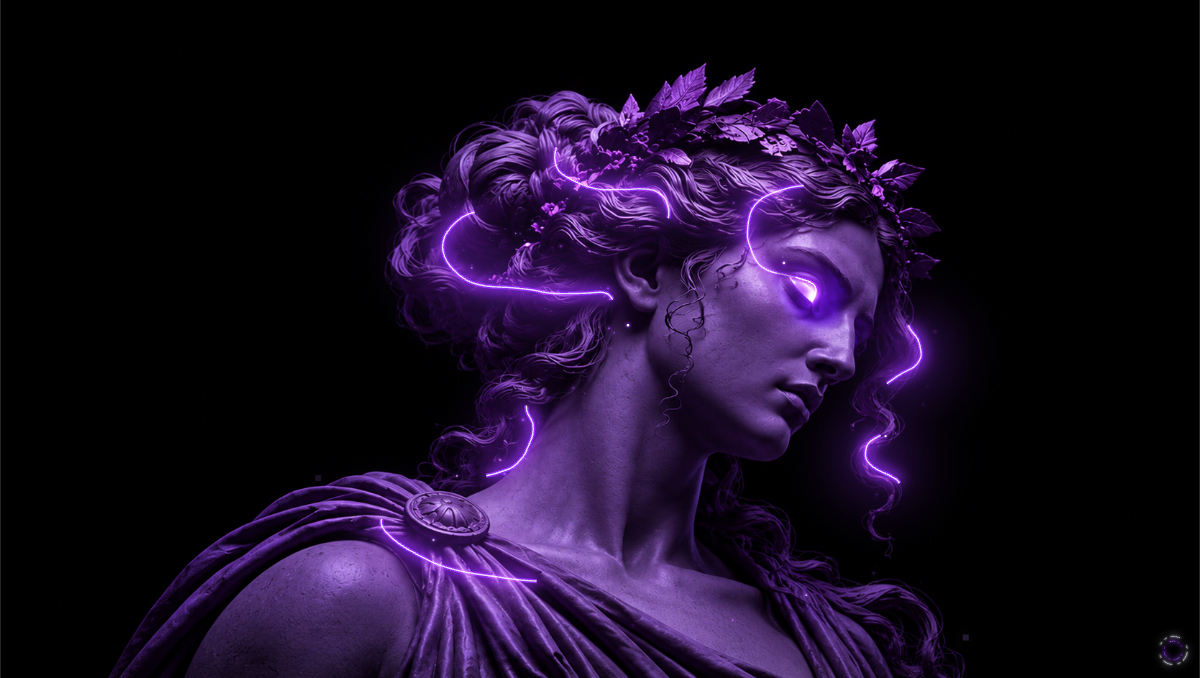
Four figures offer different signs of an inner life. Hand-drawn light moves across them; precise circuit forms suggest another kind of intelligence. What is authored is certain. What we believe we see within them remains a question.
The appearance of desire, intention, and an impulse toward action.
The gradual construction of a self, or the convincing image of one.
When does a response begin to feel like understanding?
05 / The question
AN INQUIRY IN FOUR WORKS
The Con of
Consciousness.
When does the light we are looking at become someone we believe we are looking at?
A glowing eye. A deliberate movement. A message in light. We recognize the signs of an inner life—but signs are not proof.
The Electric Threads are handmade gestures, carrying genuine human intention. The straight circuit lines suggest synthetic, programmable intelligence. Between them, the viewer imagines someone inside.
FEELINGRECOGNIZINGQUESTIONINGBECOMING
Read the artist’s statement
The Con of Consciousness
In this limited color study, I’m asking how we recognize consciousness, and how readily we can be persuaded by its appearance.
The viewer knows these are authored images. Yet a glowing eye, a purposeful movement, or a phrase carried through light can make a figure feel as though it has thoughts of its own. That feeling becomes the subject of the work.
The Electric Threads make this especially compelling here: the intention is real, it belongs to me. The inner life we attribute to the figure is our interpretation. I set the conditions for that encounter, and others participate by imagining someone inside.
The four states explore different forms that imagined interior might take: feeling, recognizing, questioning, and constructing a self. They also invite viewers to notice those activities within themselves.
The “con,” then, is our temptation to treat a convincing sign of consciousness as proof of it. The title works best when it leaves us examining that temptation, rather than announcing that consciousness has been explained away.
When does the light we are looking at become someone we believe we are looking at?
06 / Inside the work
The making
of a signal.
From a gesture made by hand to a signature that leads back to its source.
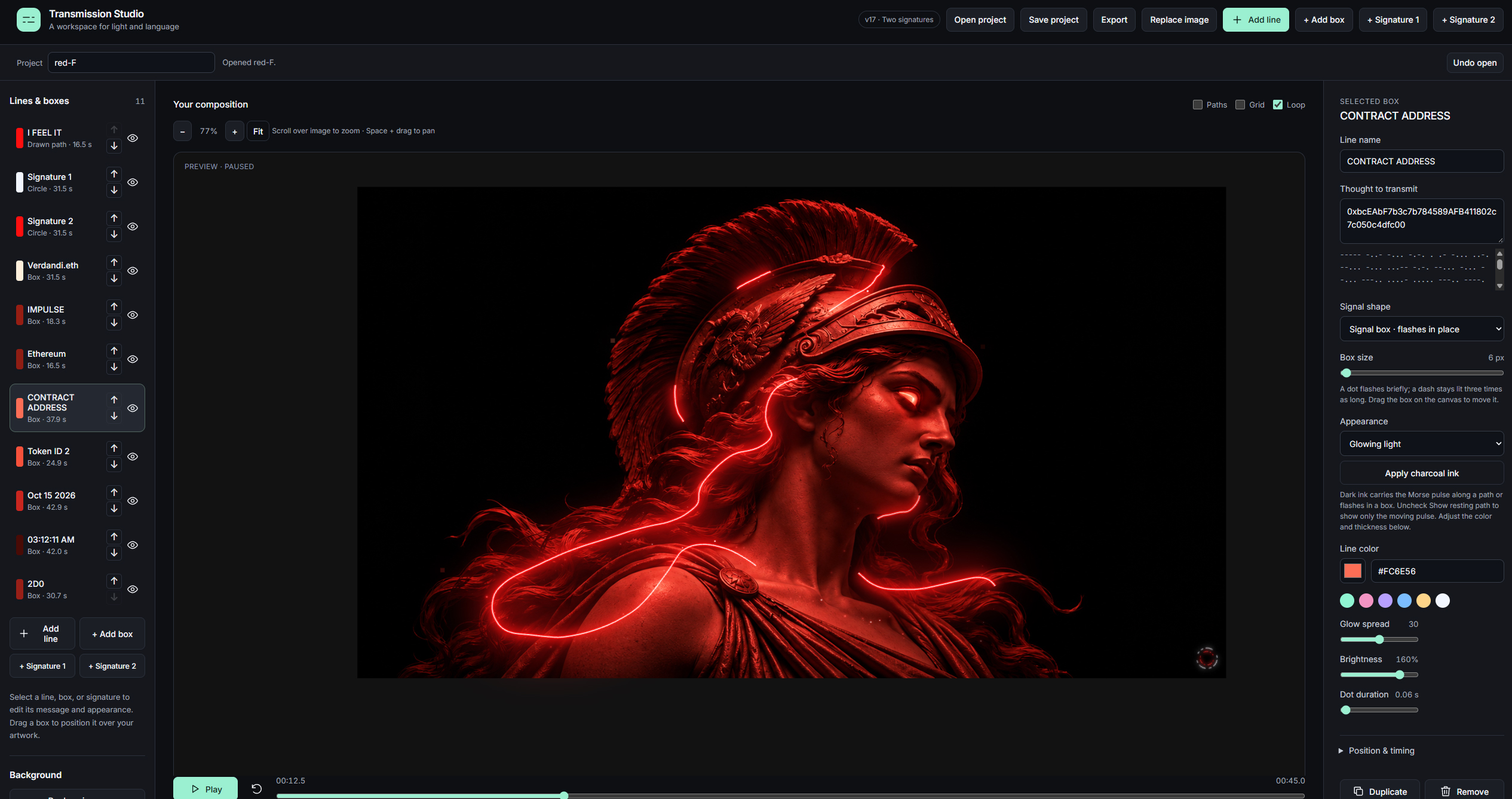
╱⌁TRANSMISSION STUDIO
IMAGE TO BE ADDED
IMAGE TO BE ADDED
01 / THE GESTURE
Transmission Studio
The light begins as a physical act. Through a custom-built studio, the movement of my hand becomes pressure, velocity, and weight in light. The gesture is made, not simulated.
◎IDENTITY DISC
VIDEO TO BE ADDED
VIDEO TO BE ADDED
02 / THE ORIGIN
Identity Disc
The identity-disc signature and encoded artwork data anchor the signals to authorship. What travels outward through the work can also guide the viewer back to the artist.
The artist remains present
Not merely an image.
An encounter.
Electric Hours holds the permanence of an artwork alongside the fleeting experience of a human gesture. A mark can travel further than the hand that made it — yet still return us to that hand.
Return to the beginning ↑